Mugwort tempura


<Ingredients>
Mugwort
Potato starch
Cake flour
Rice oil
Salt
water
〈how to make〉

I'm going to gather mugwort.
Be sure to check for car exhaust, the use of herbicides, and pet walking paths.
Avoid areas near fields where pesticides may have been used.
There are more than 40 species of mugwort found in Japan. I like the spring mugwort with red, slender stems.

Sometimes I accidentally pick up the surrounding grass, but sorting it out on the spot makes it easier to handle after taking it home.

Wash thoroughly with water.
If making tempura, there is no need to remove the bitterness. (I'll also introduce the method for removing the bitterness later.)

I used rice oil.
三和油脂 みづほ rice oil900g

Wild grasses are definitely "Umino-sei", right? lol
海の精(Umino-sei)

I added a little cake flour and potato starch. Add a little water to adjust the viscosity. I also recommend adding miso here.

Use cooking chopsticks to press the mugwort and shape it, adjusting the amount of batter as needed.

A radiation thermometer is useful. Always add the ingredients at around 180°C.
A&D Radiometer AD-5617

Take it out when the sound is a bit higher. I sprinkled salt on it before eating.
↓How to Remove Scale

Boil plenty of salted water, then add the wild plants.

Once the wild greens have turned vibrant, remove them while still boiling and soak them in water.
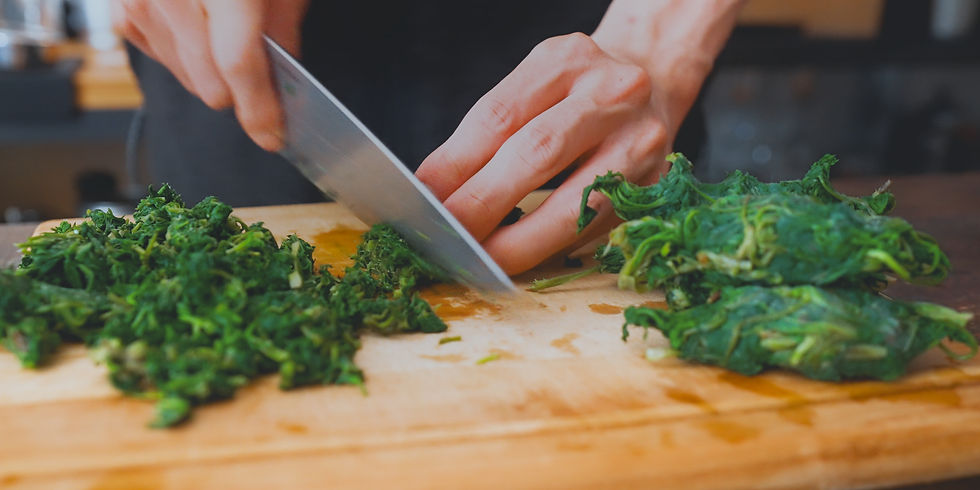
Squeeze out the excess water, chop it finely, and then store it in a Ziploc bag in the freezer. You can tear it and use it whenever you want.

When the scum appears, the water becomes cloudy like this.

If there are still wild herbs you want to purge, you can do so by adding salt while the water is still boiling and then adding the extra herbs, without having to discard the water each time.
What I find most appealing about wild plants is that money has the potential to defy the idea that they are good for health.
With enough money, you should be able to live with quality ingredients and a good environment, and you can also receive quality healthcare.
It doesn't apply to everyone who is wealthy, but there are definitely more healthy options available.
As long as you have the knowledge and know the right places, wild plants can provide food for free and also have medicinal properties.
Wild plants can be found all around us; they are very resilient and grow wherever they are.
I think wild plants are something that people of Japan should know about now and in the future.
Japan's food self-sufficiency rate was over 70% in 1965, but in recent years it has dropped to around 40%.
So that means they rely on imports for more than half of it.
In recent Japan, issues such as global warming, abnormal weather, and natural disasters like volcanic eruptions and earthquakes have often led to poor vegetable harvests and soaring prices.
Due to a declining birthrate and an aging population, the agricultural population and GDP are decreasing, and the country's purchasing power is also declining.
Globally, issues such as environmental problems, population growth, and food shortages are becoming increasingly serious.
I think there are only a very small number of people in Japan who are currently struggling with food, but the time may come when many will face similar difficulties.
If crops like vegetables suffer a global failure, I think it could become difficult to obtain them even if you have a lot of money.
When extreme weather persists, vegetables suffer poor yields and prices soar, but wild grass continues to grow vigorously and can be obtained for free.
As long as you know the knowledge and the places, you can incorporate wild plants into your life.
However, compared to the past, the number of buildings and paved roads has increased, reducing the areas available for foraging wild plants.
Most of the wild grass that grows is considered a weed and treated as a nuisance, so it is often cut or treated with herbicides.
In the past, the Japanese incorporated wild plants into their lives in various ways, such as for food, tea, medicine, textiles, dyeing, and decoration.
One of the pleasures of life in the Edo period was foraging for wild plants.
Until vegetable cultivation became more widespread, edible wild grasses and mountain vegetables were gathered in early spring.
In addition to being foraged for food, it seems that the purpose of gathering wild grass was also to leave the crowded streets of Edo and refresh oneself in nature.
In the Edo period, earthquakes, floods, volcanic eruptions, and erratic weather led to the three great famines of Kyōhō, Tenmei, and Tenpō.
In such times, wild grasses and mountain vegetables, which were not greatly affected by the weather, became a valuable source of food.
Crops that can grow and yield relatively good harvests even when ordinary crops are poor, or plants that serve as food during famines, are called famine-relief foods or reserves of food.
To promote knowledge of famine relief food and encourage stockpiling, the “Ihōshū” was published in 1783 and the “Katemono” in 1802 during the Edo period.
Centered around the chief retainer, it was written by physicians based on literature and personal experience, documenting around 144 kinds of famine-relief plants across approximately 50 categories, along with their specific cooking methods, and was distributed to the farmers and townspeople of the Yonezawa Domain—now Yamagata Prefecture—to prepare for famines.
About 30 years after the issuance of the “Katemono,” the Tenpō Great Famine occurred in 1833, but it is said that not a single person in the territory died of starvation.
It is said that, in the following years, they continued to rely on katemono to secure food during famines and crop failures caused by natural disasters.
Although the roots of wild plants go far back, even before the Edo period, Japan has a long-standing culture of wild plant appreciation passed down through generations.
However, these have been replaced by Western medicine and American food culture after the war.
In today's world, where food shortages are a concern, wild plants deserve more attention, and I think it would be a good idea to be informed about them.
Wild plants are often rich in nutrients and contain more vitamins, minerals, calcium, and enzymes than vegetables.
These days, vegetables grown organically or naturally are gaining more attention, but wild plants are pesticide-free and fertilizer-free, right?
Conventionally cultivated vegetables sold in general supermarkets are contaminated with pesticides and chemical fertilizers, and most of them are now F1 hybrids.
As a result, while the vegetables do swell, many of them have a reduced nutritional value and lack vitality.
The causes commonly referred to as "new malnutrition" include an unbalanced diet and a lack of vegetables, but it is also believed that issues with conventional farming and changes in the natural environment are related to the increase in various physical and mental illnesses in modern times.
If conventional farming is a result of consumers seeking low prices, I hope people will consider incorporating wild plants into their lives—those that are nutrient-rich, pesticide-free, fertilizer-free, and available at no cost.
I’d like to discuss some practical points, but there are a few things to keep in mind when actually foraging for wild plants.
First, collect them in a place you know well.
Be sure to check for car exhaust, the use of herbicides, and pet walking paths.
Avoid areas near fields where pesticides may have been used.
Also, be careful of poisonous plants.
Please collect only those that can be reliably identified by looking them up in field guides or similar resources.
These kinds of wildflower encyclopedias and books on natural therapy contain photos and descriptions of wild plants.
Please make use of information available on the internet.
Also, I’d like you to be careful not to overharvest.
If you overharvest them or pull them out by the roots, the plant will be eradicated.
In the worst-case scenario, I may not be able to collect the same wild plants from the same location next year.

コメント